
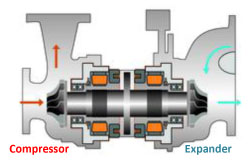
An expander-compressor, also referred to as a turboexpander-compressor or simply a turboexpander, refers to a machine with a common shaft, with a centrifugal expander wheel on one end, expanding gas with a temperature of less than 300° C (570°F), and a centrifugal compressor wheel on the opposite end. Over 550 AMB expander-compressors are installed and in service as of 2015, in gas processing facilities around the world.

Typical AMB Expander-Compressor Characteristics
Speed 6 – 70 kRPM
Power 0.2 – 14 MW (.27 – 18.7 kHP)
Radial AMB diameter 50 – 240 mm (2.0 – 9.5”)
Shaft mass 4 – 600 kg (9 – 1320 lb)

Operational AMB Expander-Compressor Note the diffuser cone (far –right), and white ice-ball surrounding the cold expander volute (right), and the thermal protective blanket around the hot compressor volute (left). Photo courtesy the Atlas-Copco Mafi-Trench Corporation.
Typically the compressor impeller is the larger of the two wheels. Gas flow for the expander is radially inwards, axially outwards. Gas flow for the compressor is the opposite – axially inwards, radially outwards. Applications for AMB expander-compressors fall into two categories.
In these applications, the expansion of a gas for refrigeration purposes is the desired output of the machine. By passing through the expander’s inlet guide vanes and impeller, energy is removed from the process gas, resulting in a lower gas temperature and pressure. The process gas is a mixture of hydrocarbons, from which the heavier compounds can liquefy and drop out during the expansion process. These liquids can be condensed and recovered, and are either a profitable by-product or the primary desired output of the refrigeration process. Specific examples of expander-compressor use for refrigeration are natural gas liquid separation, ethylene plant refrigeration and air separation.
Pressure let down energy recovery process
In these applications, the recovery of useful work from a high-temperature and/or high-pressure gas is the desired output of the machine. For example, a high-pressure process gas could be expanded to a lower pressure (which may have ancillary process benefits), driving a compressor which provides pressurized air for combustion or some other plant purpose. A familiar example of this type of machine is an automotive turbocharger, where the expansion of hot exhaust gasses drives a compressor which provides pressurized engine combustion air.


